Last night, as I was falling asleep, something crossed my mind that I wanted to write about, something that I thought would make a good blog post. I remember thinking, I should start a draft of this or send myself a text so I remember tomorrow and can actually write the piece. The comfortable, sleepy part of my mind said, “Nah, you’ll remember. We’ll think about nothing but that before we fall asleep, and you’ll remember first thing! Just relax, you had a shit day!” Did any of that thinking or remembering actually happen? No. Not at all. Not even a little. That lazy little piece of my brain hung on to that coziness and let me forget all about the inspiration! And all day, I had this nagging piece of my brain obsessing over it. “What the hell was that topic? I really wanted to write about that! It was a great idea!” Suffice it to say that I won’t be doing that again the foreseeable future, even if it means getting less sleep.
Tag: #thoughts
-
I had a conversation today that involved and led to some pretty interesting things, the first of which was a question. If you read this blog often enough, you know that I’ve written a few posts lately pondering the reason for human existence and such. The question was this – am I ok with the fact that I may never have an answer to that question? That I may have to take a stand and come to my conclusion with insufficient or incomplete information? The answer to that, in short, is a resounding no. Actually, “Hell no” is probably more appropriate. I am not ok with having a question that I will or may never have an answer to. I never have been. I think that’s the drive behind these posts. I’m searching for the answer, and talking myself through the logic and the available data. It’s what I do.
I should also add that I need to have answers that I can understand. Not necessarily agree with, but understand the reasoning or logic behind. That’s part of the reason I lost faith in God. I had a question when I was younger, and the only answer I could get was, “It is God’s will.” or, “God works in mysterious ways.” These answers, to me, were bullshit. Flat out. Because I needed to know why, and the only answer I could get is because some dude I never met who has more control over my life than I do wanted it that way, or because said dude was doing some straight up sneaky shit and fucking with my life in the process. Even before that, I always had to understand the answer. It has to make sense to me. I’ve driven some people in my life crazy with that.
Anyway, back to the question from today. No, I’m not ok with that, but on a side note, who says I have to come to a conclusion with incomplete data? I don’t have to do that. I have signed no contract, there’s no gun to my head. I can search for and think about this question until the end of my days and if there is no point at which I can comfortably come to a conclusion, so what? What happens? I die with a question on my mind. Big fucking deal. I can tell you this though, if that ends up being the case, I will not die with the regret of never searching for the answer.
Another interesting thing that came up today was a theory. This is a theory that is intertwined between neurology and psychology mainly, but takes tangents into cardiology, gastroenterology, and evolution. I’m talking about something called polyvagal theory, or PVT. I’ve done limited reading on this, but after today’s conversation, will be doing more. The human body has, according to accepted science up to this point, two main components of the nervous system. There’s the sympathetic nervous system, responsible for the “fight or flight response” that we’ve all heard so much about. Then there’s the parasympathetic nervous system, which is responsible for the opposite set of functions, also known as “rest and digest”. These two systems work to keep your body in balance. Being chased by a lion? Ok. Sympathetic nervous system kicks in, pumps out adrenaline and cortisol, increases heart rate and helps you run for your life. Made it to a tree or cave or the lion gets fed up and stops chasing you? Awesome. Parasympathetic nervous system takes over, calms you down and lets you rest for tomorrow’s adventure.
Polyvagal theory, at least from what I’ve read so far, further divides the parasympathetic nervous system into two branches. The dorsal vagal system and the ventral vagal system, dorsal related to the back and ventral related to the front, belly or underside. The dorsal vagal system is related to not only the “rest and digest” function, but also the “freeze” response – the deer in headlights. The ventral vagal system is responsible for components of social interactions, and actually has a hand in regulating the “fight or flight response” of the sympathetic nervous system via these social responses. Now, there is much much more to this than what I’ve said. Again, limited reading so far. But, fascinating, nonetheless. (Side note. Apparently, there is information in the literature that says that the dorsal vagal system is the most primitive, which actually makes sense from an evolutionary standpoint, because the first component of the complex nervous system to evolve was the chordata, which evolved to and is known in human and mammalian anatomy as the spinal cord, where all of our reflexes and other involuntary responses come from.)
Finally, part of this conversation about the parasympathetic nervous system led to a discussion of the fact that I rarely take enough time to rest, and almost never take a vacation. True statements, though I’m actively working on rectifying the first part, at least. I went through some stuff a couple of months ago that has prompted a great deal of my current thought process, and to be honest, I’m grateful for what happened and the changes it’s bringing about.
I think that’s enough rambling for now, I need sleep and have to work in the morning, like so many other people.
Have a great night!
-
I have noticed something about the world we live in. In most situations, everyone likes to talk, everyone wants to be heard, and I get that. If I have something to say that I feel is important or would bring a smile to someone’s face, I want to be heard as well. But there is certainly something to be said for simply observing.
Because of my personality, I am not one to speak over other people or raise my voice in most cases. This gives me a good deal of time to listen, and to observe those around me. Taking advantage of that opportunity is not something that a lot of people do, but it can offer some interesting insights into the behavior of other people, especially if you do so repeatedly with the same groups of people. This can be especially interesting in professional situations where you don’t necessarily know someone the way you do your friends.
Next time you are with other people, try sitting back and just observing. You may be surprised at what you are able to notice.
-
This is an interesting word.
You can get swag at a trade show, a bank, or even a doctor’s office. It’s merchandise that companies give you in the hopes that you use it and thereby promote their product or company. It’s pretty ingenious. Especially if they provide high quality swag! I still have a shirt I got from a physical therapy place years ago because it’s one of those thick, sturdy but super soft, comfortable shirts.
Random thought – band t-shirts are swag too, but you pay the band for the ability to advertise for them. Even more ingenious.
You can also give a swag – or, more appropriately, a SWAG – a Scientific Wild Ass Guess. This is where you have some data support, but not enough to say definitively, so you fill the rest with experience, judgement and luck. My favorite application of the word.
That is all. Happy Friday!
-
I did a writing prompt a few days ago that asked what your favorite word is. Now, I have a question of my own…. what is your least favorite word?
I started thinking about it, and that’s a hard question. When I was younger, it was protein. I was writing a paper for a science class, and for whatever reason, didn’t have access to a dictionary at the time. I was visiting someone, I think. Anyway, I must have crumpled up and re-written that paper two or three times because every time I wrote the word “protein” it looked wrong. And this was back in the day when you actually had to write assignments on paper with a pen.
Nowadays, I don’t know. There are certain words that I don’t like hearing some people say, because they butcher the pronunciation. Like “supposedly”. Or “administrator”. But that’s the person screwing up the word for me, not the word itself – I don’t think that counts.
I think I can actually say that I do not have a least favorite word that I can think of.
-
Something my dad told me a long time ago….
“ ‘Almost’ only counts in horseshoes, hand grenades and atom bombs.”
Simple statement, yet profound.
My dad told me this after I had been doing something, had not finished, and made the excuse that I almost finished but got tired of working on it, so I quit. He didn’t elaborate, just let me think about it. I wound up finishing whatever it was. I’ve since come to equate “almost” with “half-assed” for an abandoned project.
How many times have you accepted “almost” from others? Or, more importantly, from yourself?
-
I’m not the type of person to have tons of friends, I never have been. I have a small circle, and I like it that way.
My small circle and I have a problem. We all suck. We sometimes go months without hanging out or even talking, and every time we do talk, we say “I miss you! It’s been too long! We should hang out more!”. We muse about what we’re going to do “next time” and the fun we will have. Good times! Then, the moment passes, we part ways, and everyday life resumes her stranglehold. Weeks and months go by until we do it all over again. Vicious cycle.
I’d just like to point out that I’m saying that everyone sucks. Almost everyone is guilty of this with their friends, and maybe even with family. Too often, we let the everyday stuff get in the way of the truly important things. The connections that we have with people add so much more value to our lives than checking off to do list items.
-
Part 2 (read Part 1 here)
Upon rereading my initial post, I realize that there may be an issue with my terminology. At several points, I used the terms “reason” and “root cause” as if they were interchangeable. They are definitely related, but in this context, I am not exactly sure that they are synonymous. Let’s go to my favorite book of all time – the dictionary.
According to Merriam-Webster, there are four main definitions for the word reason:
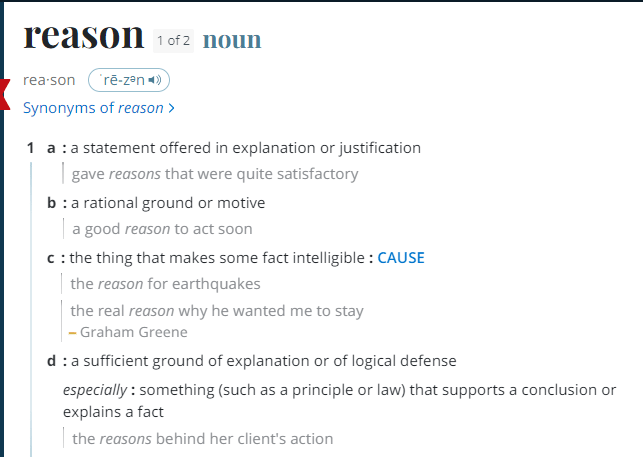
Within the third, we find the word “cause”. We’ll get into that in a minute. What strikes me for the word reason is the second definition – “a rational ground or motive”. I think this is what most of us are referring to when we talk about a reason for something. Life in particular as it relates to this discussion. We want to know what motive existence or our deity of choice had for putting us on this planet. We want a justification for our lives and the events in it. We want to know why.
Moving on to “root cause”. Oddly enough, root cause is not in the dictionary, at least not Merriam-Webster. So, we look at each part. First, cause. It is something that “brings about an effect or a result”. Second, we look at root. Now, there are several definitions depending on the field of interest, but if you look at the third definition, you see this:

What strikes me here is the first definition – the origin or source. That’s what’s being referred to when we say “the root cause”. We want to know the initial logical relationship that caused a particular event.
So, let’s take a step back. It is, apparently, impossible to define the words “reason” and “root cause” without getting into some pretty ridiculous circular logic. They are related terms, but I still think that they are not quite synonymous, because a reason carries (or can carry) an emotional connotation to it, whereas root cause – not so much. Root cause is logical. I think that distinction is what was nagging me when I reread that initial post.
I guess what it boils down to for this discussion is, what are we actually looking for? The root cause is pretty easy, it’s science. Sperm and egg get together, and voilà, human life. Events are just as easy to explain. They are logical relationships to previous events.
But the reason – the justification – is what I’m looking for. Is there a justification for human life, or is it truly random and therefore meaningless?
-
I actually misheard a song lyric a while back, but what I thought I heard actually sparked an interesting set of thoughts in my mind.
There is a distinct difference between saying that someone “can’t” do something and saying that they “don’t” do something.
If someone can’t do something, they lack the knowledge, ability, or skills to do so. For example, I can’t frame out a building. It’s a simple fact. I would have no clue how to do it properly.
If someone doesn’t do something, it may be that they are perfectly capable of whatever task or action; they simply choose not to. For example, I am capable of being a salesperson, but I made a choice not to do so as my profession.
I think more people need to realize and appreciate that in some (if not many) cases, a person is nice or good because they choose to be, not because they lack the ability to be mean or rude or even violent.
It’s an important fact to remember – you never truly know what someone might be capable of. Just because they don’t does ~not~ mean that they can’t.
 A Peculiar Cerebral Tangle