I have noticed something about the world we live in. In most situations, everyone likes to talk, everyone wants to be heard, and I get that. If I have something to say that I feel is important or would bring a smile to someone’s face, I want to be heard as well. But there is certainly something to be said for simply observing.
Because of my personality, I am not one to speak over other people or raise my voice in most cases. This gives me a good deal of time to listen, and to observe those around me. Taking advantage of that opportunity is not something that a lot of people do, but it can offer some interesting insights into the behavior of other people, especially if you do so repeatedly with the same groups of people. This can be especially interesting in professional situations where you don’t necessarily know someone the way you do your friends.
Next time you are with other people, try sitting back and just observing. You may be surprised at what you are able to notice.
You can get swag at a trade show, a bank, or even a doctor’s office. It’s merchandise that companies give you in the hopes that you use it and thereby promote their product or company. It’s pretty ingenious. Especially if they provide high quality swag! I still have a shirt I got from a physical therapy place years ago because it’s one of those thick, sturdy but super soft, comfortable shirts.
Random thought – band t-shirts are swag too, but you pay the band for the ability to advertise for them. Even more ingenious.
You can also give a swag – or, more appropriately, a SWAG – a Scientific Wild Ass Guess. This is where you have some data support, but not enough to say definitively, so you fill the rest with experience, judgement and luck. My favorite application of the word.
I did a writing prompt a few days ago that asked what your favorite word is. Now, I have a question of my own…. what is your least favorite word?
I started thinking about it, and that’s a hard question. When I was younger, it was protein. I was writing a paper for a science class, and for whatever reason, didn’t have access to a dictionary at the time. I was visiting someone, I think. Anyway, I must have crumpled up and re-written that paper two or three times because every time I wrote the word “protein” it looked wrong. And this was back in the day when you actually had to write assignments on paper with a pen.
Nowadays, I don’t know. There are certain words that I don’t like hearing some people say, because they butcher the pronunciation. Like “supposedly”. Or “administrator”. But that’s the person screwing up the word for me, not the word itself – I don’t think that counts.
I think I can actually say that I do not have a least favorite word that I can think of.
I have found that some people are severely lacking in this particular skill set. Some people need so desperately to prove something about themselves that they pay little to no mind to what the other person is saying. And if both people are doing it, the conversation is fucking pointless. It’s just two (or more) people exchanging hot air and noise. I don’t get it.
Here are the basics for good listening:
1 – shut your fucking pie hole
2 – listen to what the person is saying rather than thinking about what you’re going to say next
3 – take a moment to process what they’ve said and formulate a response
“ ‘Almost’ only counts in horseshoes, hand grenades and atom bombs.”
Simple statement, yet profound.
My dad told me this after I had been doing something, had not finished, and made the excuse that I almost finished but got tired of working on it, so I quit. He didn’t elaborate, just let me think about it. I wound up finishing whatever it was. I’ve since come to equate “almost” with “half-assed” for an abandoned project.
How many times have you accepted “almost” from others? Or, more importantly, from yourself?
I’m not the type of person to have tons of friends, I never have been. I have a small circle, and I like it that way.
My small circle and I have a problem. We all suck. We sometimes go months without hanging out or even talking, and every time we do talk, we say “I miss you! It’s been too long! We should hang out more!”. We muse about what we’re going to do “next time” and the fun we will have. Good times! Then, the moment passes, we part ways, and everyday life resumes her stranglehold. Weeks and months go by until we do it all over again. Vicious cycle.
I’d just like to point out that I’m saying that everyone sucks. Almost everyone is guilty of this with their friends, and maybe even with family. Too often, we let the everyday stuff get in the way of the truly important things. The connections that we have with people add so much more value to our lives than checking off to do list items.
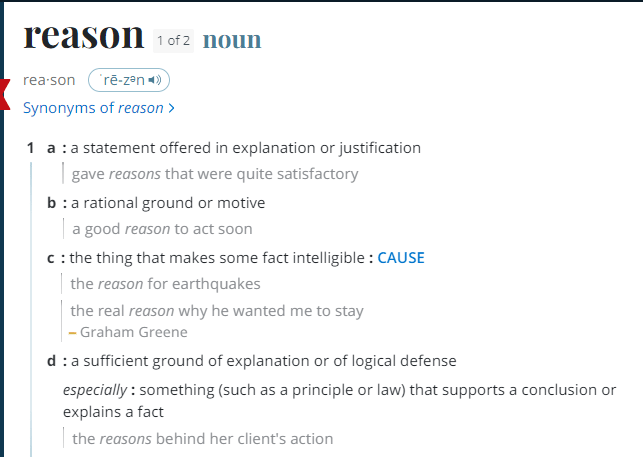
Upon rereading my initial post, I realize that there may be an issue with my terminology. At several points, I used the terms “reason” and “root cause” as if they were interchangeable. They are definitely related, but in this context, I am not exactly sure that they are synonymous. Let’s go to my favorite book of all time – the dictionary.
According to Merriam-Webster, there are four main definitions for the word reason:
Within the third, we find the word “cause”. We’ll get into that in a minute. What strikes me for the word reason is the second definition – “a rational ground or motive”. I think this is what most of us are referring to when we talk about a reason for something. Life in particular as it relates to this discussion. We want to know what motive existence or our deity of choice had for putting us on this planet. We want a justification for our lives and the events in it. We want to know why.
Moving on to “root cause”. Oddly enough, root cause is not in the dictionary, at least not Merriam-Webster. So, we look at each part. First, cause. It is something that “brings about an effect or a result”. Second, we look at root. Now, there are several definitions depending on the field of interest, but if you look at the third definition, you see this:
What strikes me here is the first definition – the origin or source. That’s what’s being referred to when we say “the root cause”. We want to know the initial logical relationship that caused a particular event.
So, let’s take a step back. It is, apparently, impossible to define the words “reason” and “root cause” without getting into some pretty ridiculous circular logic. They are related terms, but I still think that they are not quite synonymous, because a reason carries (or can carry) an emotional connotation to it, whereas root cause – not so much. Root cause is logical. I think that distinction is what was nagging me when I reread that initial post.
I guess what it boils down to for this discussion is, what are we actually looking for? The root cause is pretty easy, it’s science. Sperm and egg get together, and voilà, human life. Events are just as easy to explain. They are logical relationships to previous events.
But the reason – the justification – is what I’m looking for. Is there a justification for human life, or is it truly random and therefore meaningless?
I actually misheard a song lyric a while back, but what I thought I heard actually sparked an interesting set of thoughts in my mind.
There is a distinct difference between saying that someone “can’t” do something and saying that they “don’t” do something.
If someone can’t do something, they lack the knowledge, ability, or skills to do so. For example, I can’t frame out a building. It’s a simple fact. I would have no clue how to do it properly.
If someone doesn’t do something, it may be that they are perfectly capable of whatever task or action; they simply choose not to. For example, I am capable of being a salesperson, but I made a choice not to do so as my profession.
I think more people need to realize and appreciate that in some (if not many) cases, a person is nice or good because they choose to be, not because they lack the ability to be mean or rude or even violent.
It’s an important fact to remember – you never truly know what someone might be capable of. Just because they don’t does ~not~ mean that they can’t.
I don’t spend much time on social media, but I’ve seen the comments section on some posts full of argumentative nonsense. If – and that’s a very big IF – I comment on someone’s post, I have a few criteria for said comment before doing so.
Questions that must have an affirmative answer:
Will it make the person who posted the original thing smile/laugh?
Will it comfort the person who posted the original thing?
Does it provide verifiable information that I have to someone who doesn’t have that information?
Questions that must have negative answer:
Will it create or add to drama or other such bullshit? (i.e. – would I be arguing with someone just to argue rather than having an intelligent conversation?)
Is it flat out mean? (Sarcasm on friend’s posts doesn’t count, they know me)
And that’s pretty much it. Just sharing for the hell of it.
A person will come into your life and make jail time seem like an acceptable consequence for actions you really want to take. Like punching them in the face. Because they’re being dumb. Or an asshole. Or a dumb asshole.