I have come to realize that people are nice for different reasons.
Some people are nice simply out of adherence to social convention.
Some people are nice because they are manipulating you; they need or want something from you.
Some people are nice because they are just a nice person, and may even be a bit naive.
Some people are nice because they have walked through hell and fought demons every single day at some point in their lives, and perhaps still do. All the while, the world goes on as usual, expecting normal things from people in very abnormal circumstances.
The problem lies in the fact that you never truly know which category a person falls into, and you may never know. This is why it is important to always be kind, but also important to protect yourself. This may mean saying no if you need to, establishing boundaries, and so on. This may also mean not taking advantage of someone’s niceness, because you may not want to find out what the other side of that person looks like.
This is my favorite question; has been since I was a little kid.
I remember one instance in particular, I was maybe 4 or 5 years old. I was walking into a store with my mom, chattering away about whatever crossed my mind, likely asking a bunch of questions in the process. I remember asking my mom why the sky is blue. She got exasperated, sighed, and told me that I ask too many questions.
In all of my 4-or 5-year-old glory, I was unphased, and responded adamantly, “Mommy, why do I ask too many questions?”. She sighed again and told me to hush. I continued to, and to this day, ask a lot of questions. I actually have a tattoo on the back of my neck that says “question everything”.
I know that I may never have the answer to all of the “why” questions that I ask, either out loud or in my mind, and that’s ok. I also understand that the answers I have now may change as science evolves and uncovers even deeper truths. Either way, I will continue to search for answers.
I’m probably gonna date myself here, but I don’t care.
I liked the yellow pages for finding companies. You could look up a category – lawyers, furniture, dentists, whatever – and get a listing of all the businesses of that type in your area. You know your area, so could tell by the town names how far away they are. Maybe you had a friend who used a particular company and told you they loved dealing with that company. Noted. Maybe a coworker had a horrible experience with a different company. Also noted. (Mental filing cabinets are your friends!!)
My point is, I don’t want some algorithm to show me only the results that it thinks I’d be interested in. I also don’t want another algorithm to bombard me with ads for shit I have no interest in just because I was curious about one thing on a random fucking Tuesday a few weeks ago. I don’t want to see sponsored listings for something only remotely related, or from companies that pay to subvert other companies by having their info at the top of the results list. I want to see ~all~ of my options, speak to a human being when I call, and make my own informed decision about who I’m going to give my business to. Just sayin.
Part 4 was a discussion of the scarier points of a random universe, but ended with a question about free will, which I’d like to get into now. To start, we will consult Merriam-Webster.
There are two ways to write this word — freewill and free will, the former being an adjective, the latter a noun. We are interested in the noun, so here we go:
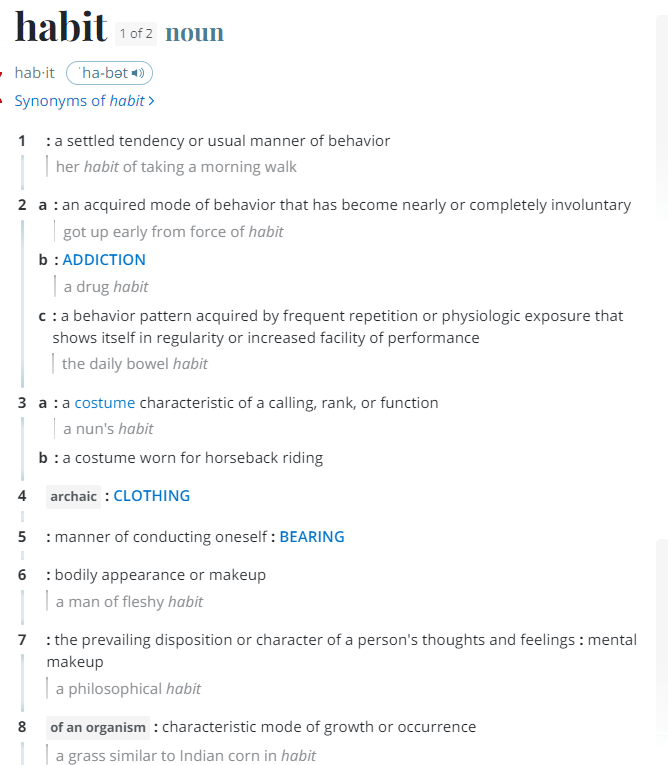
Free will is making a choice on your own, but can that rule out randomness? Habits come to mind, which makes me think that yes, free will can rule out the idea that all choices are random.
But what about those choices not related to habit? And, to expand on that, how many of our choices are not related to habitual behavior? For example, if you are a frugal person, and see a dollar on the sidewalk, you’re likely to pick it up. If not, you may just walk on by. That choice to pick up the dollar or not, is related to a quality that you have – being frugal. And it creates certain habits, even if you did not consciously work to establish said habit. That leads to the conclusion that the type of person we are – frugal, a career person, an animal person, etc. – determines the types of habits we have and the choices we make. That, in turn, makes me think that all of our choices are related to habit, and if that is the case, not random.
Additionally, are there any random habits? The more I think about this, I think that any choice that we make is based on habit. But we can choose to forego habitual behavior. For example, I attended a baby shower today. I purchased non-practical gifts for said event. This was out of character for me, since I tend to err on the side of practicality when it comes to gifts for big events like birth or marriage.
Let’s take a moment to consult the dictionary again:
Habits are usual, regular, or recurring events or modes of behavior. Random is random – it could be any of the choices, with equal probability of each; the flip of a coin. Human beings are creatures of habit. If you have a particular value, such as honesty, or frugality, then your behaviors tend to reinforce that value. In other words, your choices reflect your values. Habits are value based. Can values be random? I lean towards no on this, because values have a purpose, and can have or cause a pattern.
A random thought, how do instincts fall into this? Instincts are predictable behaviors, but not one that a choice is made about.
This needs some additional thought before I continue. Prepare for part 6!
I hate rude people. They hereby, if it was not made clear previously, officially qualify for Asshole status. If you’re in a meeting and make a phone call without warning and without excusing yourself, that is rude. If you tolerate intense background noise on a call that makes you difficult to hear, and then expect the other person to just deal with it, you are rude. If you cut someone in a long line for something without good reason and without asking, you are rude. If, in general, you do not consider other people in your day-to-day interactions around other people, and ask, or excuse yourself before doing something that will interrupt, inconvenience, or in some way negatively impact them, then you are rude, and by extension, an asshole.
Beliefs are interesting things, because there is no fact behind them; there is no objective evidence. And yet, violence – wars, even – happen because of beliefs.
I saw an interesting clip on FB a while back, and there were two dudes talking, and the one said, “Don’t you know that belief is a doubt?” and the other dude says, “How is belief a doubt?” and the original dude says, “Because you cannot believe something and know it.” and he goes on to explain that “you can only believe in what you don’t know.” (here’s a link to the clip on Youtube) It was really intriguing, and certainly pertains to this discussion. If I know something – I know I woke up this morning, or that I had steak and shrimp for dinner last night, I don’t have to believe those things. They happened; I witnessed them. Or, as the dude in the video points out, I know my parents, I don’t believe in them. But, I’ve never met Santa Clause, so as a child, I had to believe in him. It’s a perspective I never considered.
On to more thinking, and brooding that it’s too cloudy to see the meteor shower.
I have issues with Neil deGrasse Tyson because he demoted Pluto, but the man is amazing intellectually, without a doubt.
This is… insane. Light has no clock, no age. I just…. I can’t even process this right now, being almost midnight, but I have to get into this more. Einstein was right, and in a way that corresponds to the absolute core of how the universe operates. How does this impact things that I’ve been thinking about? What might this mean for life in general? What are the implications? The faster that you move, the less time exists for you. What!? The existence and impact of time is based on a condition.
My mind is reeling, I can’t write right now, I need to process.
When I was in college, I had to write a research paper, the subject matter had to be something from the 60s. It was the final paper for the class and would account for a ridiculous portion of the final grade. The professor was extremely conservative, and didn’t appreciate an outspoken, pierced, tattooed chick with a purple mohawk in her very distinguished honors English 101 class. Let’s just say we would butt heads often. So, being the sarcastic, somewhat vindictive rebel that I was, I decided to fuck with her and write a kick ass paper on how the use of LSD became popular in that timeframe and imagined the mental pain it would cause her to have to give me an A on the paper and in the class all because of a paper about illicit drug use.
I started researching. The main topic was going to be Timothy Leary, his impressive education and career, and the fact that he would encourage people to do acid. However, my research took a turn in a whole different direction when I came across something about classified CIA experiments with LSD. (They were declassified in the early 2000s) I dug into it, and oh my, the things I found!
During the project code named MK-Ultra, the goal was to find an effective method of mind control or a type of truth serum. Initial efforts focused on LSD, and included sometimes unwitting subjects from both the US and Canada. The “research” also employed other hallucinogens, as well as shock therapy, and various forms of torture. They expanded to include some crazy shit with barbiturates and amphetamines administered back to back in an effort to produce an uninhibited state where the subject would just answer questions truthfully. They also would tape therapy sessions, give the subject LSD, then put them in a sensory deprivation tank or solitary confinement and play back the most horrible moments from the taped therapy on a loop, just to see how that would impact the person. Seriously sick shit – several people died as a result of this fucking insane quest for mind control.
I wound up writing a killer, scathing research paper about this project. And yes, I got an A, albeit with some disparaging comments from the professor about the opinions insinuated in the paper.
When I was kid, we had Dirty Dancing on VHS. My mom loved that movie, and so did my sister and I. We’d be enjoying the final scene, with the entire audience getting up to dance, Patrick Swayze and Jennifer Grey looking so in love with their arms around each other…. *sigh*
And then, enter VHS static, and the (very loud!) chorus line and dancing girls of “Anything Goes” in the opening scene of Indiana Jones and the Temple of Doom. Thanks to my half deaf dad for that one. I loved the Indiana Jones movies too, but the transition was hilarious and made my mom mad every single time!
Just a thing to share. No deep thoughts, hopefully just smiles for those who know the movies I’m talking about.
I have noticed something about the world we live in. In most situations, everyone likes to talk, everyone wants to be heard, and I get that. If I have something to say that I feel is important or would bring a smile to someone’s face, I want to be heard as well. But there is certainly something to be said for simply observing.
Because of my personality, I am not one to speak over other people or raise my voice in most cases. This gives me a good deal of time to listen, and to observe those around me. Taking advantage of that opportunity is not something that a lot of people do, but it can offer some interesting insights into the behavior of other people, especially if you do so repeatedly with the same groups of people. This can be especially interesting in professional situations where you don’t necessarily know someone the way you do your friends.
Next time you are with other people, try sitting back and just observing. You may be surprised at what you are able to notice.


 A Peculiar Cerebral Tangle